
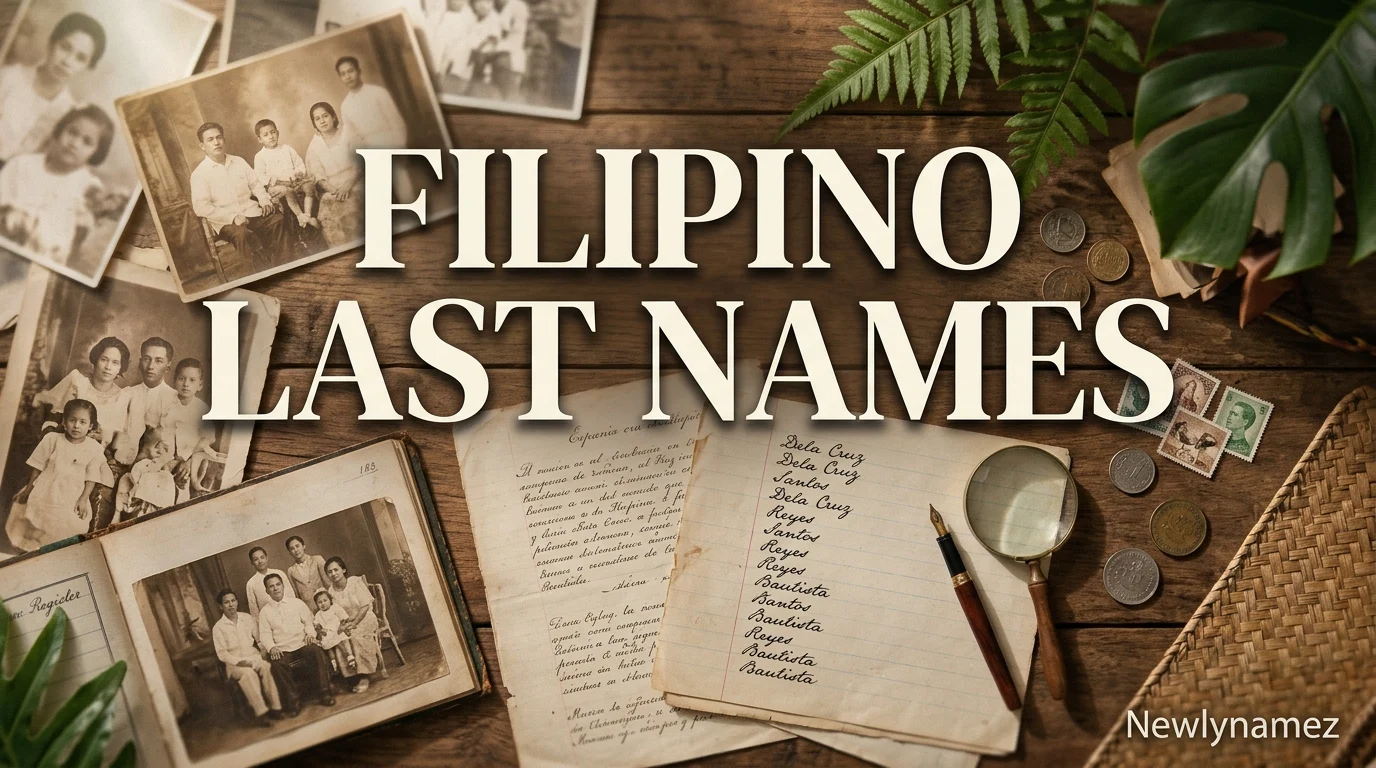
Filipino last names carry stories that connect generations, preserve family traditions, and celebrate the rich cultural identity of the Philippines. Whether you are researching your family tree, choosing a character name, exploring Filipino heritage, or simply curious about beautiful Filipino surnames, every name offers an opportunity to discover something meaningful about history and identity.
From familiar surnames like Santos, Reyes, and Cruz to distinctive names like Magbanua, Dalisay, and Dimagiba, Filipino family names reflect centuries of cultural influences. Spanish colonial history, indigenous languages, Chinese migration, and regional traditions have all contributed to the country’s fascinating surname landscape.
Some Filipino last names sound elegant and traditional, while others are short, modern, uncommon, or deeply connected to particular regions. Understanding these names can help you appreciate the diversity of Filipino families and the stories passed down through generations.
In this guide, you’ll discover popular Filipino last names, their possible meanings and origins, unique surnames, traditional family names, and helpful ideas for researching Filipino ancestry.
Understanding Filipino Last Names and Their Origins
Filipino surnames have a fascinating history. Many families have Spanish-influenced last names because of Spanish colonial rule, which lasted for more than three centuries.
In 1849, Spanish Governor-General Narciso Clavería issued a decree introducing a standardized surname system. The Catálogo alfabético de apellidos (Alphabetical Catalog of Surnames) helped organize family names across the Philippines.
However, not every Filipino surname is Spanish. Many come from indigenous Filipino languages, Chinese family names, local words, occupations, geographical locations, and other cultural influences.
Here are some common sources of Filipino surnames:
- Spanish influence: Santos, Reyes, Cruz, Garcia, and Mendoza.
- Indigenous Filipino heritage: Magbanua, Dalisay, Dimagiba, and Maliksi.
- Chinese influence: Lim, Tan, Sy, and Co.
- Geographical connections: Surnames associated with towns, provinces, and ancestral communities.
- Traditional family names: Surnames passed down through generations and preserved through family history.
An important detail is that having a Spanish-looking surname does not necessarily mean a Filipino family has Spanish ancestry. Likewise, a surname’s meaning can vary depending on its linguistic roots and historical context.
200+ Filipino Last Names and Surnames
Here is a collection of Filipino family names, including familiar, traditional, distinctive, and less common options.
Popular Filipino Last Names
These surnames are widely recognizable in Filipino communities and are often encountered in family records, schools, workplaces, and everyday life.
- Santos
- Reyes
- Cruz
- Garcia
- Mendoza
- Bautista
- Flores
- Gonzales
- Ramos
- Aquino
- Castillo
- Rivera
- Fernandez
- Dela Cruz
- Torres
- Villanueva
- Perez
- Martinez
- Lopez
- Rodriguez
- Santiago
- Diaz
- Herrera
- Navarro
- Morales
Traditional Filipino Last Names
Traditional Filipino surnames often carry a strong sense of family heritage and cultural continuity. Many have been preserved for generations.
- Agustin
- Alonzo
- Andres
- Angeles
- Arellano
- Barrios
- Cabrera
- Calderon
- Campos
- Carpio
- Castro
- Chavez
- Contreras
- Cortez
- Domingo
- Espiritu
- Evangelista
- Francisco
- Fuentes
- Galang
- Guevarra
- Jimenez
- Lorenzo
- Macapagal
- Mercado
Beautiful Filipino Last Names
These surnames have distinctive sounds and an elegant appearance. They can also be interesting choices for fictional characters, creative projects, and family-history research.
- Dalisay
- Magbanua
- Maliksi
- Dimagiba
- Marasigan
- Manalo
- Balagtas
- Bayani
- Alcaraz
- Belmonte
- Buenaventura
- Del Rosario
- De Guzman
- De Leon
- De Vera
- Delos Reyes
- Lacsamana
- Lualhati
- Magsaysay
- Salazar
- Samonte
- Sarmiento
- Soriano
- Valdez
- Vergara
Unique and Uncommon Filipino Last Names
If you are looking for something less familiar, these surnames offer a distinctive selection. Their frequency can vary significantly between provinces and communities.
- Abad
- Abella
- Almeda
- Amador
- Arceo
- Baluyot
- Banaga
- Banzon
- Bascos
- Batac
- Belen
- Benitez
- Bituin
- Caballes
- Cabangon
- Cagang
- Cajucom
- Catacutan
- Dacumos
- Dizon
- Esguerra
- Fajardo
- Gatchalian
- Hilario
- Ilagan
Filipino Last Names With Spanish Influence
Spanish-influenced surnames are particularly recognizable throughout the Philippines. Some originated as Spanish words or family names, while others became established through the colonial-era surname system.
- Alvarado
- Benavides
- Bernardo
- Blanco
- Bonifacio
- Bravo
- Camacho
- Castañeda
- Cervantes
- Corazon
- Delgado
- Escobar
- Espinosa
- Estrella
- Flores
- Hidalgo
- Iglesias
- Jimenez
- Miranda
- Montoya
- Ocampo
- Ortega
- Pacheco
- Palacios
- Panganiban
Filipino Last Names With Chinese Influence
Chinese migration and settlement have played an important role in Philippine history. Chinese-origin surnames are especially visible in Filipino-Chinese communities, although spelling and romanization can differ.
- Lim
- Tan
- Sy
- Co
- Chua
- Ong
- Uy
- Go
- Lee
- Yu
- Lao
- Tiu
- Ang
- Chan
- Ho
- Kho
- Kuan
- Kwek
- Sia
- Yao
Filipino Last Names From Indigenous and Local Heritage
These surnames offer a glimpse into the country’s linguistic and cultural diversity. Some are associated with Filipino words, regional languages, or local family traditions.
- Abesamis
- Alipio
- Amang
- Balane
- Banal
- Bañez
- Barlis
- Baylon
- Caballero
- Cabiling
- Dagohoy
- Dela Peña
- Dumlao
- Gamboa
- Gatmaitan
- Lacsina
- Lantaca
- Macaraeg
- Malabanan
- Manansala
- Mangubat
- Panaligan
- Salcedo
- Tanjutco
- Yumul
More Filipino Family Names
Here are additional surnames to expand your collection and help you discover even more possibilities.
- Alonzo
- Araneta
- Balmaceda
- Bonifacio
- Briones
- Candelaria
- Capistrano
- Carandang
- Dimaculangan
- Enriquez
- Escalante
- Evangelista
- Ferrer
- Gozon
- Javier
- Lacson
- Ledesma
- Legaspi
- Manrique
- Montemayor
- Natividad
- Ongpin
- Pineda
- Quinto
- Regalado
- Roxas
- Sevilla
- Teodoro
- Trinidad
- Zulueta
Filipino Last Names and Their Meanings
One of the most interesting things about Filipino surnames is that some have meanings rooted in everyday language, nature, personal qualities, and ancestral traditions.
However, not every surname has a single confirmed meaning. Some have Spanish or Chinese linguistic roots, while others have meanings that depend on the Philippine language from which they originated.
Here are some notable examples:
Filipino surname
Commonly associated meaning or origin
Dalisay
Pure or genuine
Magbanua
Associated with a town or settlement
Maliksi
Agile or quick
Panganiban
Associated with strength
Dimayuga
Unshakeable
Dimaano
Untouchable
Dimagiba
Associated with something that cannot be broken
Bituin
Star
Bayani
Hero
Dalisay
Pure or sincere
Mandigma
Warrior
Puno
Leader or head; interpretation depends on context
Bantugan
Famous or renowned
Tanglao
Torch or light
Banaag
Radiance or glow
Bondoc
Mountain or hill
Bacolod
Hill
Santos
Saints
Reyes
Kings
Cruz
Cross
Flores
Flowers
Del Rosario
Of the rosary
Estrella
Star
Castillo
Castle
Rivera
Riverbank
Mendoza
Spanish family-name origin
Lim
Chinese surname, commonly associated with the Lin surname
Tan
Chinese surname, commonly associated with Chen
Chua
Chinese surname, commonly associated with Cai
Ong
Chinese surname, commonly associated with Wang
These examples illustrate how Filipino surnames preserve different linguistic traditions. The meanings should be treated as linguistic associations rather than guaranteed explanations of an individual family’s ancestry.
Kifa St+2
Short and Simple Filipino Last Names
Short surnames are easy to recognize, pronounce, and remember. Many also have interesting historical or cultural backgrounds.
Here are some examples:
- Tan
- Lim
- Sy
- Co
- Uy
- Go
- Lee
- Yu
- Lao
- Ang
- Ho
- Abad
- Cruz
- Ong
- Roxas
- Dizon
- Puno
- Belen
- Chan
- Kho
These names are useful starting points when exploring Filipino naming traditions, but their simplicity does not indicate anything about a family’s social background or ancestry.
Strong and Powerful Filipino Last Names
Some Filipino surnames have associations with leadership, bravery, heritage, and strength. They can be particularly interesting for historical research and fictional character creation.
Consider these names:
- Bayani
- Mandigma
- Panganiban
- Macapagal
- Macabulos
- Lacandola
- Gatmaitan
- Mangubat
- Balagtas
- Dagohoy
- Dimayuga
- Dimaano
- Puno
- Bantugan
- Araneta
Some of these names have connections to indigenous words, historical figures, or traditional titles. Their individual family histories may differ, so a surname alone cannot establish noble ancestry or historical rank.
Elegant Filipino Last Names for Girls and Boys
Filipino surnames are generally inherited family names rather than names assigned according to gender. Nevertheless, some have a particularly elegant sound and work beautifully for fictional characters, stories, and creative writing.
Elegant surname ideas:
- Villanueva
- Del Rosario
- Buenaventura
- Valdez
- Vergara
- Soriano
- Salazar
- Montemayor
- Ledesma
- Araneta
- Zulueta
- Castañeda
- Marasigan
- Dalisay
- Magbanua
Modern-sounding surname ideas:
- Reyes
- Rivera
- Castillo
- Mendoza
- Navarro
- Santiago
- Valdez
- Lacson
- Pineda
- Javier
Traditional-sounding surname ideas:
- Bautista
- Evangelista
- Francisco
- Mercado
- Ocampo
- Panganiban
- Manalo
- Gatmaitan
- Macapagal
- Lacsamana
Filipino Last Names Beginning With Different Letters
If you are searching for a Filipino surname alphabetically, this quick reference can make your search easier.
Letter
Filipino last names
A
Aquino, Agustin, Alonzo, Araneta
B
Bautista, Bautista, Belmonte, Briones
C
Cruz, Castillo, Campos, Cabrera
D
Dizon, Domingo, Dela Cruz, Dalisay
E
Espiritu, Evangelista, Enriquez, Escalante
F
Flores, Fernandez, Ferrer, Fajardo
G
Garcia, Gonzales, Galang, Gatchalian
H
Herrera, Hidalgo, Hilario, Hernandez
I
Ilagan, Ignacio, Iglesias, Imperial
J
Javier, Jimenez, Jacinto, Jalandoni
L
Lopez, Lim, Lacson, Ledesma
M
Mendoza, Manalo, Mercado, Marasigan
N
Navarro, Natividad, Nieves, Noble
O
Ocampo, Ong, Ortega, Ongpin
P
Perez, Pineda, Panganiban, Pacheco
R
Reyes, Ramos, Rivera, Roxas
S
Santos, Santiago, Salazar, Soriano
T
Tan, Torres, Trinidad, Teodoro
V
Valdez, Villanueva, Vergara, Villamor
Y
Yu, Yumul, Yambao, Yabut
Z
Zulueta, Zamora, Zarate, Zuniga
Note: This is an illustrative alphabetical selection, not a complete national surname directory. Some names have multiple spellings.
Filipino Last Names That Are Perfect for Fictional Characters
Are you creating a Filipino character for a novel, screenplay, role-playing game, or online story? Choosing a surname that fits the character’s personality and background can make the character feel more believable.
Here are some combinations to inspire you:
Character style
Suggested full name
Brave hero
Adrian Bayani
Mysterious character
Gabriel Salazar
Romantic lead
Isabella Villanueva
Intelligent student
Daniel Reyes
Historical figure
Emilio Macapagal
Adventurous explorer
Rafael Magbanua
Artistic personality
Sofia Dalisay
Wealthy businessman
Sebastian Araneta
Independent heroine
Elena Mendoza
Traditional family member
Miguel Bautista
Fantasy warrior
Lucas Mandigma
Modern protagonist
Andrea Castillo
These are fictional combinations, not claims about real individuals or family histories.
Filipino Family Names and Their Emotional Significance
A surname can mean more to a family than a word written on a document. It can represent grandparents, parents, siblings, distant relatives, and generations of people who helped shape a family’s identity.
Here are a few meaningful reflections inspired by Filipino family heritage:
- A family name carries memories that deserve to be cherished.
- Every generation adds a new chapter to its family’s story.
- Our roots remind us where we started and inspire us to keep growing.
- A surname connects us to people whose stories came before ours.
- Family heritage is a gift that becomes more meaningful when shared.
- The beauty of a family name lives in the love and values behind it.
- Our ancestors may be gone, but their stories continue through us.
- Respecting our roots is one way of honoring those who came before.
- A family’s greatest legacy is not its name but the kindness it passes down.
- Every family has a history worth discovering.
These reflections are suitable for family-history posts, genealogy projects, heritage celebrations, and social media captions.
Filipino Last Names for Social Media Captions
If you are sharing your Filipino heritage on Instagram, Facebook, Pinterest, or WhatsApp, a meaningful caption can make your post more memorable.
Here are some short and heartfelt caption ideas:
- Proud of my Filipino roots and family heritage.
- My surname is part of a story that began generations ago.
- Carrying my family’s legacy with love and pride.
- Filipino heritage, endless stories, and beautiful traditions.
- My roots are my strength.
- A name connects generations, but love makes a family.
- Celebrating the culture that shaped who I am.
- My family name, my history, my identity.
- Every surname has a story worth discovering.
- Proud of where my family comes from.
One-Line Filipino Heritage Quotes
These short quotes are ideal for profile descriptions, status updates, family albums, and heritage-themed posts.
- “Our roots make our stories beautiful.”
- “A family name is a bridge between generations.”
- “Filipino heritage is a treasure worth preserving.”
- “Honor your ancestors by living with kindness.”
- “Your roots are part of your strength.”
- “Every family name deserves a story.”
- “Culture connects hearts across generations.”
- “Remember your beginnings while creating your future.”
- “Family history is a gift worth passing on.”
- “Proud roots, meaningful traditions, and endless possibilities.”
How to Choose the Right Filipino Last Name
Choosing a Filipino surname for a character, family-history project, or creative purpose becomes easier when you understand what you want the name to communicate.
Here are five useful tips:
1. Consider the cultural background. Filipino surnames can have Spanish, indigenous, Chinese, and other linguistic origins. Think about the character’s or family’s background before choosing one.
2. Look for meaningful associations. Names such as Dalisay, Bayani, and Bituin have interesting associations with purity, heroism, and stars.
3. Think about pronunciation. Choose a surname that fits naturally with the first name and is comfortable to pronounce.
4. Explore regional history. Filipino naming traditions differ across Luzon, Visayas, and Mindanao. Regional languages and community histories can provide valuable clues.
5. Research real family connections. If you are investigating your own ancestry, look beyond the surname. Birth certificates, baptismal records, marriage documents, and historical archives can help establish family relationships.
How to Research Your Filipino Family Name
If your goal is to understand your actual family history, a surname list is only the beginning.
Try these steps:
- Ask older relatives about grandparents and great-grandparents.
- Collect old photographs, family documents, and birth certificates.
- Identify the province, town, or barangay associated with your ancestors.
- Search historical church and civil registration records.
- Look into the 1849 Catálogo alfabético de apellidos.
- Compare different spellings of your family surname.
- Record names, dates, and relationships as you discover them.
The National Archives of the Philippines and historical genealogy resources can help you investigate older records. The University of the Philippines Diliman has also published research explaining the linguistic and historical origins of Filipino family names.
UP Diliman+2
One important warning: sharing a surname with another Filipino family does not automatically prove that you are related. The 1849 surname decree and other historical naming practices mean that surname-based assumptions can be misleading.
When Should You Explore Filipino Last Names?
Learning about Filipino surnames can be useful for several different purposes.
Situation
How surname research helps
Family genealogy
Discovering ancestral connections
School assignments
Learning about Philippine history
Writing fiction
Creating culturally appropriate characters
Cultural celebrations
Appreciating Filipino heritage
Immigration records
Understanding historical name variations
Family reunions
Sharing stories across generations
Personal identity
Exploring family traditions and roots
Whether you are researching your ancestors or simply interested in Filipino culture, learning about surnames is a wonderful way to understand the country’s diverse history.
FAQs
1. What are the most common Filipino last names?
Some widely recognized Filipino surnames include Santos, Reyes, Cruz, Garcia, Mendoza, Bautista, Flores, Gonzales, Ramos, and Aquino. These names reflect the historical influence of Spanish naming traditions and the development of Filipino family names.
2. Why do many Filipinos have Spanish last names?
Many Filipinos have Spanish-influenced surnames because of Spanish colonial history. In 1849, Governor-General Narciso Clavería introduced a decree that standardized surname usage through a catalog called the Catálogo alfabético de apellidos. Local authorities distributed surnames to families who needed them for official records and administration.
UP Diliman+1
3. What is the most beautiful Filipino last name?
Beauty is subjective, but surnames such as Dalisay, Magbanua, Villanueva, Marasigan, Salazar, and Buenaventura are attractive choices for their distinctive sounds and cultural associations.
Dalisay, for example, is associated with purity, while Magbanua has a connection to settlement or town-dwelling in some linguistic explanations.
4. Are all Filipino last names Spanish?
No. Filipino surnames have diverse origins, including Spanish, indigenous Philippine languages, Chinese, and other linguistic traditions. Names such as Dalisay, Panganiban, and Maliksi demonstrate the influence of indigenous languages, while Lim, Tan, and Chua reflect Chinese heritage.
UP Diliman+1
5. What are some rare Filipino last names?
Some less commonly encountered or distinctive Filipino surnames include Magbanua, Lacsamana, Tanjutco, Yumul, Cajucom, Bituin, Dimaculangan, and Gatmaitan.
However, rarity depends on location and community. A surname that is uncommon nationally may be familiar in a particular province.
6. How can I find out the meaning of my Filipino last name?
Start by identifying the language and historical background of your surname. Ask relatives about your family’s ancestral province, examine historical documents, and consult Filipino surname dictionaries and linguistic research.
You can also investigate the 1849 Catálogo alfabético de apellidos. Remember that some surnames have multiple possible meanings, so historical evidence is important.
7. Do Filipino last names reveal a person’s ancestry?
Filipino surnames can offer clues about linguistic, geographical, and historical influences, but they cannot independently establish someone’s ancestry. Many families adopted surnames through historical administrative processes, and unrelated families may share the same surname. Genealogical documents and family records provide stronger evidence.
Conclusion
Filipino last names are more than simple family identifiers. They reflect a remarkable mixture of cultures, languages, traditions, and historical experiences. From familiar surnames like Santos, Reyes, and Cruz to distinctive names like Dalisay, Magbanua, and Panganiban, each offers an opportunity to appreciate the Philippines’ rich cultural heritage.
Whether you are searching for popular Filipino surnames, exploring beautiful family names, writing a fictional character, or researching your ancestors, remember that a surname is only one part of a much bigger story.
Your family’s traditions, values, memories, and experiences give that name its deeper significance. Take time to learn about your roots, listen to the stories of older generations, and preserve the history that makes your family unique.
Because every family name has a past, every generation creates a future, and every heritage deserves to be remembered.
