
Japanese names are admired around the world for their beautiful sounds, meaningful kanji, and deep cultural symbolism. Some Japanese names are associated with life, nature, strength, and happiness, while others can evoke darker themes such as death, endings, shadows, mourning, and the mysterious beauty of the afterlife.
If you are searching for Japanese names that mean death, you may be looking for a mysterious character name, a dark fantasy identity, a meaningful username, or an unusual name for a fictional story. Perhaps you want a name that represents transformation, the end of an old chapter, or the quiet beauty of life’s impermanence.
Japanese culture has a particularly rich relationship with these themes. Concepts such as yūgen (幽玄), the mysterious depth of existence, and mono no aware (物の哀れ), the bittersweet awareness that everything is temporary, offer beautiful ways to explore mortality through language and art.
However, an important distinction matters: not every Japanese name associated with darkness or death literally means death. Japanese meanings depend heavily on kanji combinations, pronunciation, and context. Some entries below are genuine words or symbolic name ideas rather than traditional given names.
This collection explores Japanese words meaning death, dark and mysterious name ideas, feminine and masculine options, anime-inspired names, and symbolic alternatives that capture mortality without losing their poetic beauty.
Whether you are naming a fictional character, creating a gaming identity, writing a fantasy novel, or exploring Japanese language and mythology, these ideas will help you find a name with the atmosphere and meaning you want.
Japanese Words and Names That Literally Mean Death
The Japanese language has several words directly connected to death, dying, and mortality. These are useful starting points when researching names with dark meanings.
Japanese word
Reading
Meaning
死
Shi
Death
死亡
Shibō
Death; passing away
死神
Shinigami
Death god or death spirit
死者
Shisha
Dead person; deceased
死霊
Shiryō
Spirit of a dead person
亡霊
Bōrei
Ghost; departed spirit
冥界
Meikai
Underworld
黄泉
Yomi
Underworld or land of the dead
臨終
Rinju
Final moments of life
終焉
Shūen
End; final conclusion
Important: These are Japanese vocabulary words, not all suitable personal names. In particular, 死 (shi) is strongly associated with death and is generally avoided in ordinary personal naming.
Beautiful Japanese Names and Words Inspired by Death
Not every dark Japanese name needs to have a frightening meaning. Some words communicate the sadness of separation, the mystery of the afterlife, or the beauty of an ending.
Here are some poetic Japanese-inspired options.
- Yomi (黄泉) — The underworld in Japanese mythology.
- Shizuka (静か) — Quiet or peaceful; a symbolic name for stillness.
- Rei (霊) — Spirit or soul.
- Tamashii (魂) — Soul or spirit.
- Kage (影) — Shadow.
- Yūrei (幽霊) — Ghost or spirit of the deceased.
- Mei (冥) — Dark, obscure, or associated with the netherworld.
- Kurayami (暗闇) — Darkness.
- Yami (闇) — Darkness.
- Mugen (夢幻) — Dreamlike illusion or something transient.
- Shūen (終焉) — The end or final conclusion.
- Hakai (破壊) — Destruction.
- Mu (無) — Nothingness or absence.
- Kokū (虚空) — Emptiness or the void.
- Makai (魔界) — Demon realm.
- Reikon (霊魂) — Spirit or soul.
- Oboro (朧) — Hazy, indistinct, or misty.
- Kasumi (霞) — Mist or haze.
- Yoru (夜) — Night.
- Kuro (黒) — Black.
Naming note: These are a mixture of established Japanese words, poetic concepts, and name-like readings. Their suitability as actual Japanese given names varies.
Japanese Girl Names Associated With Death and Darkness
Japanese feminine names can have delicate sounds while carrying mysterious, melancholic, or symbolic meanings. If you are creating a fictional female character with a dark personality, these options offer different shades of meaning.
- Yami (闇) — Darkness.
- Yoru (夜) — Night.
- Rei (霊) — Spirit.
- Mei (冥) — Darkness or the netherworld.
- Kage (影) — Shadow.
- Oboro (朧) — Haze or indistinct mist.
- Kasumi (霞) — Mist.
- Shizuka (静) — Calm or quiet.
- Tsukiyo (月夜) — Moonlit night.
- Kuroha (黒羽) — Black feather.
- Ruka (流華) — A possible creative kanji combination suggesting flowing flowers.
- Hotaru (蛍) — Firefly.
- Kohaku (琥珀) — Amber.
- Shion (紫苑) — Aster flower.
- Yukari (紫) — Purple, depending on the kanji.
- Mizuki (水月) — Water and moon, a poetic combination.
- Rin (凛) — Dignified or coldly elegant.
- Setsuna (刹那) — A fleeting instant.
- Tsukiko (月子) — Moon child.
- Hikari (光) — Light, a symbolic contrast to darkness.
These names are particularly useful when you want a character who represents mystery, loneliness, elegance, or the relationship between life and death.
Japanese Boy Names Associated With Death, Shadows, and the Underworld
If you want a masculine Japanese name with a dark, powerful, or mysterious feeling, consider words connected to shadows, spirits, warriors, and the supernatural.
These suggestions are especially useful for fictional heroes, villains, anime characters, and fantasy protagonists.
- Shinigami (死神) — Death god or death spirit.
- Shiryō (死霊) — Spirit of a deceased person.
- Bōrei (亡霊) — Ghost or departed spirit.
- Kuro (黒) — Black.
- Kage (影) — Shadow.
- Yami (闇) — Darkness.
- Rei (霊) — Spirit.
- Mei (冥) — Netherworld or obscurity.
- Akumu (悪夢) — Nightmare.
- Ankoku (暗黒) — Deep darkness.
- Raijin (雷神) — Japanese thunder deity.
- Oni (鬼) — Demon or ogre.
- Kuronushi (黒主) — Creative dark-themed character name.
- Kurotsuki (黒月) — Black moon; creative combination.
- Yamiyo (闇夜) — Dark night.
- Makai (魔界) — Demon realm.
- Kokuyō (黒曜) — Obsidian or black volcanic glass.
- Shura (修羅) — Asura; a fierce fighting spirit in Buddhist traditions.
- Mugen (無限) — Infinity.
- Kurojin (黒人) — Black person in ordinary usage; not recommended as a dark character name because of its real-world racial meaning.
Best for: Dark fantasy characters, supernatural stories, gaming identities, and mysterious fictional personalities.
Japanese Unisex Names With Dark and Mysterious Meanings
Some Japanese readings can be used for different genders depending on their kanji and naming context. These options offer a balance of simplicity, elegance, and mystery.
- Rei (零) — Zero or nothing.
- Rin (凛) — Dignified and composed.
- Akira (明) — Bright or clear.
- Haru (春) — Spring.
- Nagi (凪) — Calm, windless sea.
- Sora (空) — Sky.
- Aoi (葵) — Hollyhock; also associated with the color blue or green through other kanji.
- Mizuki (水月) — Water and moon.
- Itsuki (樹) — Tree.
- Kaoru (薫) — Fragrance.
- Makoto (誠) — Sincerity.
- Chihiro (千尋) — A name with multiple possible interpretations depending on kanji.
- Nozomi (望) — Hope or wish.
- Shin (真) — Truth.
- Yū (悠) — Calm, distant, or enduring.
- Kiri (霧) — Fog.
- Tsuki (月) — Moon.
- Kō (光) — Light.
- Ren (蓮) — Lotus.
- Izumi (泉) — Spring or fountain.
These are generally more suitable as name-like choices than words such as Shinigami or Shiryō. Their actual meanings depend on the written characters selected.
Japanese Names Inspired by Ghosts and Spirits
Japanese folklore has a fascinating collection of supernatural beings, spirits, and mysterious creatures. These names and words are ideal for fictional characters with connections to the spirit world.
- Yūrei (幽霊) — Ghost.
- Onryō (怨霊) — Vengeful spirit.
- Ikiryō (生霊) — A living person’s spirit believed to leave the body.
- Goryō (御霊) — A spirit traditionally associated with a deceased person, sometimes believed to cause misfortune.
- Shiryō (死霊) — Spirit of the dead.
- Bōrei (亡霊) — Departed spirit or ghost.
- Reikon (霊魂) — Soul or spirit.
- Seirei (精霊) — Spirit or elemental being.
- Mononoke (物の怪) — Supernatural entity or mysterious spirit.
- Yōkai (妖怪) — Supernatural creature.
- Nue (鵺) — A legendary Japanese chimera-like creature.
- Tsuchigumo (土蜘蛛) — A legendary spider-like supernatural being.
- Jorōgumo (絡新婦) — A spider yōkai that can take human form.
- Rokurokubi (轆轤首) — A supernatural being with an elongated neck.
- Kitsune (狐) — Fox, often associated with supernatural abilities in folklore.
- Kappa (河童) — Water-dwelling yōkai.
- Tengu (天狗) — A supernatural mountain being.
- Oni (鬼) — Demon or ogre.
- Zashiki-warashi (座敷童子) — A childlike household spirit.
- Shinigami (死神) — Death god or death spirit.
Cultural note: Japanese folklore contains many different kinds of spirits. They are not all evil or associated with death; some are protective, playful, or connected to nature.
Japanese Names That Mean Darkness and Shadow
Darkness is a popular theme in Japanese-inspired fantasy naming because it can symbolize mystery, hidden strength, solitude, and the unknown.
Here are 20 options for people who prefer dark meanings without directly using the word death.
- Yami (闇) — Darkness.
- Kage (影) — Shadow.
- Kurayami (暗闇) — Deep darkness.
- Ankoku (暗黒) — Blackness or profound darkness.
- Yamiyo (闇夜) — Dark night.
- Kuro (黒) — Black.
- Kokutan (黒檀) — Ebony.
- Kokuyō (黒曜) — Obsidian.
- Kurotsuki (黒月) — Black moon; creative combination.
- Kurokage (黒影) — Black shadow; creative combination.
- Kiri (霧) — Fog.
- Kasumi (霞) — Mist.
- Oboro (朧) — Hazy or indistinct.
- Yoru (夜) — Night.
- Mayonaka (真夜中) — Midnight.
- Mikazuki (三日月) — Crescent moon.
- Tsukikage (月影) — Moonlight or moon shadow.
- Kokū (虚空) — Void or empty space.
- Mukyoku (無極) — Limitlessness or the ultimate; a philosophical term.
- Muen (無縁) — Without connection or ties.
Best for: Dark fantasy stories, mysterious characters, gothic usernames, and atmospheric fictional worlds.
Japanese Names Inspired by the Afterlife and Underworld
Japanese mythology and Buddhist traditions contain several concepts connected to death, the afterlife, and spiritual existence. These words can create meaningful names for fictional worlds and supernatural characters.
- Yomi (黄泉) — The land of the dead in Japanese mythology.
- Yomi no Kuni (黄泉の国) — Land of Yomi.
- Meikai (冥界) — Underworld.
- Jigoku (地獄) — Hell.
- Gokuraku (極楽) — Paradise or Pure Land.
- Anoyo (あの世) — The other world or afterlife.
- Tama (魂) — Soul or spirit.
- Tamashii (魂) — Soul.
- Reikai (霊界) — Spirit world.
- Shinkai (深海) — Deep sea; also a poetic name for an unknown world.
- Mumyō (無明) — Spiritual ignorance or darkness in Buddhist terminology.
- Metsubō (滅亡) — Destruction or downfall.
- Shūmatsu (終末) — End or final period.
- Shūen (終焉) — Final ending.
- Metsu (滅) — Destruction or extinction.
- Mujō (無常) — Impermanence.
- Hakanai (儚い) — Fleeting or transient.
- Mu (無) — Nothingness.
- Kū (空) — Emptiness; an important Buddhist concept.
- Rinne (輪廻) — Rebirth or cycle of reincarnation.
These words are especially useful for fantasy worldbuilding, symbolic character names, and stories that explore mortality and spiritual transformation.
Japanese Anime-Inspired Death Names
Anime and manga frequently explore themes of death, supernatural powers, spirits, curses, and the struggle between good and evil. If you want a Japanese-inspired name with a dramatic anime atmosphere, these ideas may be useful.
- Yami no Kage — Shadow of darkness.
- Kuro Shinigami — Black death spirit.
- Rei no Tsuki — Moon of spirits.
- Yoru no Ō — King of the night.
- Kage no Kami — God of shadows.
- Meikai no Senshi — Warrior of the underworld.
- Shinigami no Kishi — Knight of death.
- Ankoku no Tenshi — Angel of darkness.
- Kuro no Tamashii — Black soul.
- Yomi no Kishi — Knight of Yomi.
- Tsuki no Kage — Shadow of the moon.
- Mugen no Yami — Endless darkness.
- Reikon no Senshi — Warrior of spirits.
- Kuroi Hana — Black flower.
- Yoru no Reikon — Spirit of the night.
- Shura no Ō — King of the asura.
- Kokū no Kami — God of the void.
- Kage no Senshi — Shadow warrior.
- Meikai no Ō — King of the underworld.
- Yami no Tenshi — Angel of darkness.
These are creative phrases rather than established traditional Japanese personal names. Their translations are approximate and should be checked by a fluent Japanese speaker before use in a published work.
Japanese Names That Symbolize the End of Life and New Beginnings
Death can also be explored symbolically. In literature, it may represent the end of a difficult chapter, the transformation of identity, or the beginning of a completely different journey.
These Japanese words offer more subtle alternatives to names that literally mean death.
- Setsuna (刹那) — A fleeting moment.
- Mujō (無常) — Impermanence.
- Hakanai (儚い) — Fleeting or fragile.
- Mugen (夢幻) — Dreamlike illusion.
- Shūen (終焉) — Final ending.
- Owari (終わり) — Ending.
- Hajime (始め) — Beginning.
- Saisei (再生) — Rebirth or regeneration.
- Tensei (転生) — Reincarnation or rebirth.
- Rinne (輪廻) — Cycle of reincarnation.
- Kiseki (奇跡) — Miracle.
- Mirai (未来) — Future.
- Akari (明かり) — Light or illumination.
- Yoake (夜明け) — Dawn.
- Asahi (朝日) — Morning sun.
- Hikari (光) — Light.
- Nozomi (望み) — Hope or wish.
- Kibō (希望) — Hope.
- Haruka (遥) — Distant or far-reaching.
- Natsume (夏目) — A Japanese surname and name element, with meaning dependent on the characters.
These choices are particularly suitable for characters who experience loss, personal transformation, healing, or a new beginning.
Japanese Names Inspired by Death Gods and Mythological Figures
Japanese mythology and supernatural storytelling offer fascinating inspiration for dark character names. These words and figures can help create identities that feel mysterious, ancient, and powerful.
- Izanami (イザナミ) — A Japanese creation goddess associated with death and the underworld.
- Izanagi (イザナギ) — A creator deity connected with the mythological origin of life and death.
- Enma (閻魔) — Judge of the dead in Japanese Buddhist tradition.
- Shinigami (死神) — Death god or death spirit.
- Yama (閻魔) — A name associated with the Buddhist ruler of the dead.
- Hades (ハデス) — Greek god of the underworld, sometimes used in Japanese fantasy naming.
- Oni (鬼) — Demon or ogre.
- Yōkai (妖怪) — Supernatural creature.
- Tsuchigumo (土蜘蛛) — Legendary supernatural spider.
- Nue (鵺) — Mysterious legendary creature.
- Yūrei (幽霊) — Ghost.
- Onryō (怨霊) — Vengeful spirit.
- Gashadokuro (がしゃどくろ) — Giant skeleton spirit from Japanese folklore.
- Jikininki (食人鬼) — A spirit in Buddhist folklore associated with consuming human corpses.
- Rokurokubi (轆轤首) — A supernatural being with an unusually long neck.
- Kasha (火車) — A supernatural creature believed in folklore to carry away corpses.
- Shōjō (猩々) — A mythical creature associated with the sea and drinking.
- Kitsune (狐) — Fox spirit or fox, depending on context.
- Tengu (天狗) — Supernatural mountain being.
- Kappa (河童) — Water-dwelling supernatural creature.
Best for: Mythological fiction, anime characters, supernatural games, fantasy villains, and stories involving the afterlife.
Japanese Names Inspired by Death Flowers and Nature
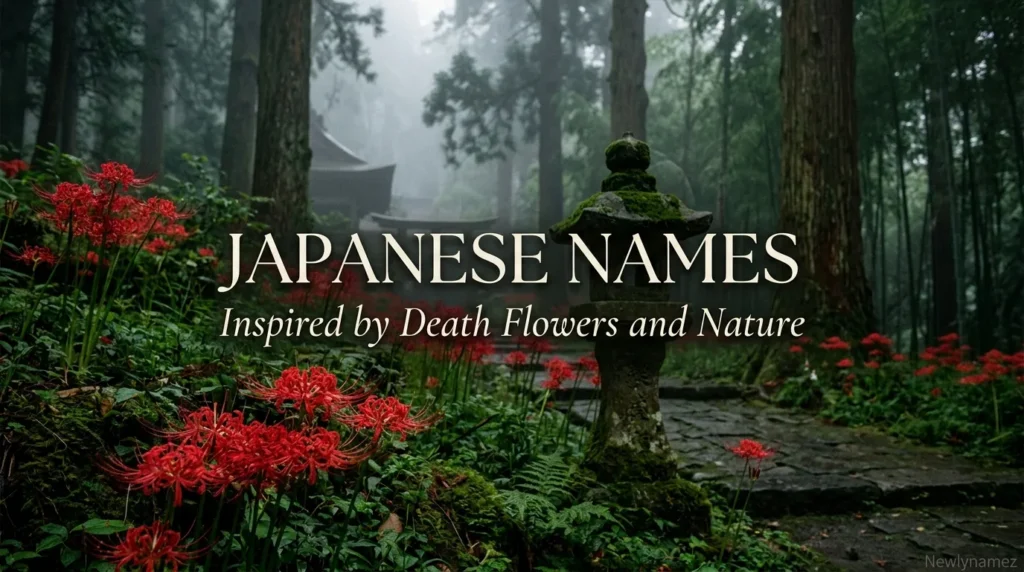
Flowers and natural elements can represent mortality, remembrance, sadness, and the temporary beauty of life. These names offer a softer approach to dark Japanese-inspired naming.
- Higanbana (彼岸花) — Red spider lily, strongly associated with death and the afterlife in Japanese cultural symbolism.
- Kuroyuri (黒百合) — Black lily.
- Shion (紫苑) — Aster flower.
- Sakura (桜) — Cherry blossom, often associated with life’s fleeting beauty.
- Yuki (雪) — Snow.
- Tsuki (月) — Moon.
- Kiri (霧) — Fog.
- Kasumi (霞) — Mist.
- Yoru (夜) — Night.
- Kage (影) — Shadow.
- Kurobara (黒薔薇) — Black rose.
- Tsubaki (椿) — Camellia.
- Botan (牡丹) — Peony.
- Suzuran (鈴蘭) — Lily of the valley.
- Kikyo (桔梗) — Bellflower.
- Hotaru (蛍) — Firefly.
- Kokutan (黒檀) — Ebony.
- Shizuku (雫) — Droplet.
- Tsukikage (月影) — Moon shadow or moonlight.
- Yūgure (夕暮れ) — Evening twilight.
Japanese Dark Fantasy Names for Villains and Antagonists
A villain’s name can reveal something about their personality, history, or supernatural abilities. These creative combinations are designed for fictional antagonists, dark fantasy stories, and role-playing games.
- Kuro no Ō — King of darkness.
- Yami no Shisha — Messenger of darkness.
- Shinigami no Kage — Shadow of the death spirit.
- Ankoku no Senshi — Warrior of darkness.
- Yomi no Ō — King of Yomi.
- Kuroi Reikon — Black spirit.
- Meikai no Ryu — Dragon of the underworld.
- Yoru no Akuma — Demon of the night.
- Kage no Maō — Shadow demon king.
- Mugen no Shinigami — Death spirit of infinity.
- Kurotsuki no Ō — King of the black moon.
- Shura no Senshi — Warrior of the asura.
- Reikon no Kishi — Knight of spirits.
- Kurayami no Ō — King of deep darkness.
- Yami no Kishi — Knight of darkness.
These are invented character-style phrases, not conventional Japanese personal names. Japanese word order and grammar can vary depending on the intended meaning.
Japanese Names With Beautiful but Sad Meanings
Sometimes a name becomes memorable because it captures an emotion rather than a frightening idea. These Japanese words express loneliness, impermanence, longing, and the quiet sadness associated with life’s passing moments.
- Setsunai (切ない) — Painfully sad or emotionally heartbreaking.
- Sabishii (寂しい) — Lonely.
- Kanashimi (悲しみ) — Sadness.
- Namida (涙) — Tears.
- Yūutsu (憂鬱) — Melancholy.
- Aishū (哀愁) — Sorrow or melancholy.
- Kodoku (孤独) — Loneliness.
- Hakanai (儚い) — Fleeting or fragile.
- Mujō (無常) — Impermanence.
- Wasure (忘れ) — Forgetting.
- Yūgure (夕暮れ) — Twilight.
- Kagerō (陽炎) — Heat haze or shimmering air.
- Oboro (朧) — Hazy or indistinct.
- Nostalgia (ノスタルジア) — Nostalgia, expressed as a borrowed word.
- Kokoro (心) — Heart or mind.
These words are especially suitable for poetry, character descriptions, artistic usernames, and stories exploring grief and remembrance.
Japanese-Inspired Names for Gaming and Social Media
If you need a mysterious username for an online game, anime-inspired account, or creative community, these combinations offer a dark aesthetic without using an actual death-related word as a personal name.
- YamiSoul
- KuroPhantom
- YomiWalker
- ShadowRei
- MidnightShinigami
- KageHunter
- DarkTsuki
- SilentYurei
- KuroHorizon
- GhostOfYomi
- MoonlitKage
- VoidTamashii
- OboroNight
- CrimsonHiganbana
- LostReikon
- EternalYami
- PhantomTsuki
- ShadowOfMeikai
- SilentKuro
- TheLastYurei
These are original username ideas rather than traditional Japanese names. Check platform availability before choosing one.
Short Japanese Death-Related Names and Words
Short words are often attractive because they are simple, memorable, and visually appealing. Here are 20 compact Japanese words and readings connected to dark or symbolic themes.
Name
Japanese
Meaning
Shi
死
Death
Rei
霊
Spirit
Yami
闇
Darkness
Yoru
夜
Night
Kage
影
Shadow
Kuro
黒
Black
Mei
冥
Netherworld or obscurity
Mu
無
Nothingness
Kū
空
Emptiness
Rin
凛
Dignified
Nagi
凪
Calm sea
Yuki
雪
Snow
Tsuki
月
Moon
Kiri
霧
Fog
Tama
魂
Soul
Oni
鬼
Demon or ogre
Yomi
黄泉
Underworld
Metsu
滅
Destruction
Rin ne
輪廻
Reincarnation
Setsuna
刹那
Fleeting moment
Japanese Death-Related Names: Important Cultural and Language Tips
Before choosing a Japanese name, it is important to understand how the language works.
Japanese names are often written using kanji, and one pronunciation can have several possible meanings depending on the characters selected.
For example:
- Rei: Can mean spirit (霊), zero (零), or gratitude/etiquette (礼), depending on the kanji.
- Mei: Can be written using different characters, including 冥, which has associations with darkness and the netherworld.
- Yuki: Can represent snow (雪), happiness (幸), or other meanings depending on its spelling.
- Kuro: Means black (黒), but it is not automatically a traditional personal name.
- Rin: Can represent dignified composure (凛) or other meanings.
A few additional points are worth remembering:
- Avoid assuming that a Japanese word is automatically a suitable first name.
- Check the kanji before using a name publicly.
- Be careful with words such as Shi (死), which have an explicitly negative meaning.
- Do not confuse supernatural folklore terms with ordinary Japanese names.
- Ask a fluent Japanese speaker to review important character names, especially for books, films, and commercial projects.
One particular example deserves attention: Kurojin (黒人) is an ordinary Japanese term meaning a Black person, not a poetic term for darkness. It should not be used as a fictional dark-name suggestion.
Heartfelt Reflections and Messages About Life, Death, and Remembrance
Although this article focuses on Japanese names, death-related themes can also inspire thoughtful reflections about life, love, and the importance of appreciating the people around us.
These original messages are suitable for personal reflections, creative writing, memorial captions, and meaningful social media posts.
1. Every ending reminds us how precious the moments we share truly are.
Tone: Reflective | Best for: Personal captions
2. May the memories of those we love remain gentle lights in our hearts.
3. Life is temporary, but kindness can leave a lasting impression.
4. May every difficult goodbye eventually make room for healing and peace.
5. Remember that even the quietest moments can carry the deepest meaning.
6. May we learn to appreciate today instead of waiting for tomorrow.
7. The beauty of life becomes clearer when we understand that every moment matters.
8. May love remain stronger than distance, time, and sorrow.
9. Even after an ending, the lessons and memories can continue to guide us.
10. May every heart experiencing loss find patience, comfort, and understanding.
11. Let gratitude remind us to cherish the people who make life meaningful.
12. May remembrance bring more warmth than sadness.
13. Every chapter has an ending, but every ending can teach us something valuable.
14. May the passing seasons remind us to live with compassion and courage.
15. A meaningful life is measured not only by its length but also by the love it leaves behind.
Short Japanese-Inspired Blessings About Peace and Healing
These original messages combine themes of peace, hope, remembrance, and renewal. They can accompany Japanese-inspired artwork, reflective posts, or fictional stories.
1. May your heart find peace even when the world feels uncertain.
2. May every shadow eventually lead you toward a little light.
3. May yesterday’s pain become tomorrow’s wisdom.
4. May the quiet beauty of life bring comfort to your soul.
5. May you find strength in remembering and courage in moving forward.
6. May your memories remain precious and your future remain hopeful.
7. May kindness follow you through every season of life.
8. May every goodbye be met with gratitude for the time you shared.
9. May the moon remind you that even darkness has its own beauty.
10. May peace grow where sadness once lived.
FAQs
1. What Japanese name literally means death?
The Japanese word Shi (死) literally means death. However, it is not generally used as an ordinary personal name because of its strong negative association. Another related word is Shinigami (死神), meaning death god or death spirit.
2. What is the Japanese name for the god of death?
Shinigami (死神) is the Japanese term commonly used for a death god or death spirit. Shinigami appear in Japanese folklore, literature, manga, and anime, although their portrayals vary across different works.
3. What Japanese girl names mean death or darkness?
Japanese words and name-inspired choices associated with darkness include Yami (闇), meaning darkness; Rei (霊), meaning spirit; Mei (冥), associated with the netherworld; and Kage (影), meaning shadow. These are not all conventional Japanese feminine names, so their suitability depends on the intended character and kanji.
4. What Japanese boy names mean death or darkness?
For masculine fictional characters, options include Kuro (黒), meaning black; Yami (闇), meaning darkness; Kage (影), meaning shadow; and Shura (修羅), referring to an asura or fierce fighting spirit. Shinigami (死神) is another supernatural term, but not a conventional boy’s name.
5. What does Yomi mean in Japanese?
Yomi (黄泉) refers to the underworld or land of the dead in Japanese mythology. It is particularly associated with the myth of Izanami and Izanagi, two important figures in Japanese creation mythology.
6. What Japanese flower symbolizes death?
Higanbana (彼岸花), commonly known as the red spider lily, is strongly associated with death, separation, remembrance, and the afterlife in Japanese cultural symbolism. It is often used in art, literature, and popular media to create a mysterious or melancholic atmosphere.
7. What are some Japanese names for dark fantasy characters?
Some popular Japanese-inspired dark fantasy choices include Yami, Kage, Yomi, Rei, Shinigami, Meikai, Kurotsuki, Oboro, and Ankoku. For original characters, combining these words can create distinctive identities, but invented combinations should be checked for natural Japanese grammar and appropriate kanji.
Conclusion
Japanese language and culture offer a fascinating way to explore themes of death, darkness, remembrance, and transformation. From Yomi, the mysterious land of the dead, to Shinigami, the supernatural death spirit, these words carry meanings that go far beyond simple translations.
Some names express the mystery of the afterlife, while others symbolize shadows, fleeting moments, spiritual existence, and the natural cycle of life. Beautiful alternatives such as Setsuna, Mujō, Higanbana, and Oboro can also communicate powerful emotions without directly referring to death.
When choosing a Japanese name, remember that its meaning depends on its kanji, pronunciation, and cultural context. A name that sounds mysterious in another language may have a very different meaning to a native Japanese speaker.
Whether you are creating an anime character, writing a dark fantasy novel, choosing a mysterious username, or simply exploring Japanese vocabulary, take time to understand the meaning behind your choice.
Ultimately, the most meaningful names are not necessarily the darkest ones. They are the ones that tell a story, express an emotion, and leave a lasting impression.
